FertiJoy IVF & Fertility
Building families beyond borders
IUI vs IVF vs ICSI: Which Fertility Treatment is Right for You?
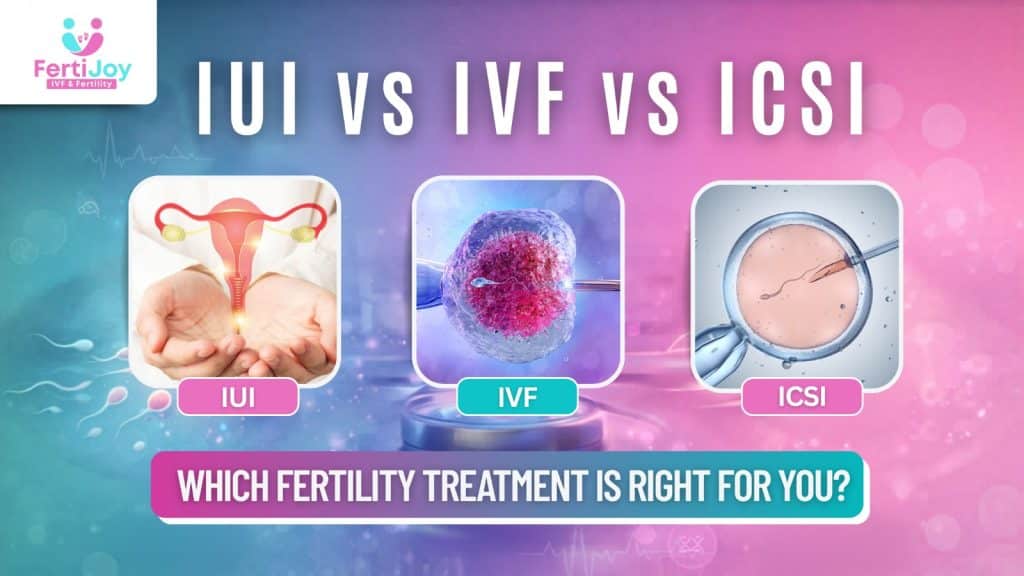
Infertility can be a challenging journey for many couples, but modern assisted reproductive technologies have opened new doors to parenthood. Among the most discussed options are Intrauterine Insemination (IUI), In Vitro Fertilization (IVF), and Intracytoplasmic Sperm Injection (ICSI). Each treatment differs in approach, complexity, and suitability, making the choice highly personal. Understanding the differences helps couples make informed decisions based on their unique medical situation.
Dr. Ramya Mishra, a renowned Fertility Specialist In New Delhi, believes that no single treatment fits everyone. A detailed evaluation of both partners is crucial before recommending any path forward.
Understanding IUI (Intrauterine Insemination)
IUI is often considered the simplest and least invasive fertility treatment. It involves placing carefully prepared sperm directly into the uterus at the time of ovulation, increasing the chances of sperm reaching the egg.
How IUI Works
The procedure starts with tracking the woman’s ovulation cycle, sometimes supported by mild medications. On the day of insemination:
- A semen sample is washed and concentrated in the laboratory to isolate the healthiest sperm.
- Using a thin, flexible catheter, the doctor places the sperm into the uterus.
The process takes only a few minutes, requires no anesthesia, and allows patients to return to daily activities right away.
Who Should Consider IUI?
IUI is commonly recommended for couples facing:
- Mild male factor infertility (slightly reduced sperm count or motility).
- Unexplained infertility.
- Cervical mucus problems.
- Ovulation irregularities when combined with medication.
- Situations involving donor sperm.
It works well when the fallopian tubes are open and there are no major fertility barriers.
Advantages and Limitations of IUI
Advantages:
- Minimally invasive with very little discomfort.
- Lower emotional and physical stress.
- Can be attempted in multiple cycles.
- Mimics natural conception more closely.
Dr. Ramya Mishra often suggests IUI as a starting point for younger couples with mild fertility concerns.
Understanding IVF (In Vitro Fertilization)
IVF is a more advanced and widely recognized fertility treatment where fertilization happens outside the body in a controlled laboratory environment.
How IVF Works
An IVF cycle usually spans 4 to 6 weeks and includes the following steps:
- Ovarian Stimulation – Medications encourage the ovaries to produce multiple eggs.
- Egg Retrieval – Mature eggs are collected through a minor ultrasound-guided procedure under sedation.
- Fertilization – Eggs are combined with sperm in the lab (standard IVF) or through ICSI.
- Embryo Development – Fertilized eggs grow into embryos over 3 to 5 days.
- Embryo Transfer – One or more selected embryos are gently placed into the uterus.
- Support Phase – Medications help support potential implantation.
Surplus embryos can be cryopreserved for future use.
Who Should Consider IVF?
IVF is suitable for a broad range of infertility causes, including:
- Blocked or damaged fallopian tubes.
- Moderate to severe male factor infertility.
- Endometriosis.
- Unexplained infertility after unsuccessful IUI attempts.
- Advanced maternal age or low ovarian reserve.
- Cases requiring genetic screening of embryos.
Advantages and Limitations of IVF
Advantages:
- Generally offers higher success rates per cycle than IUI.
- Provides greater control over the fertilization and embryo selection process.
- Effective for complex or multiple infertility factors.
- Allows embryo freezing for later attempts.
Dr. Ramya Mishra explains that IVF has transformed outcomes for couples facing significant challenges by allowing precise laboratory intervention.
Understanding ICSI (Intracytoplasmic Sperm Injection)
ICSI is a specialized fertilization technique performed as part of an IVF cycle. It involves injecting a single healthy sperm directly into a mature egg.
How ICSI Works
After eggs are retrieved in an IVF cycle:
- Embryologists examine sperm under a powerful microscope and select the best candidate.
- A fine needle is used to inject one sperm into the center of each egg.
- The embryos then develop and are transferred as in a standard IVF cycle.
This method significantly improves fertilization chances when sperm quality is a concern.
Who Should Consider ICSI?
ICSI is particularly helpful in cases of:
- Severe male factor infertility (very low count, poor motility, or abnormal shape).
- Previous IVF cycles with failed or low fertilization.
- Sperm obtained through surgical retrieval.
- Use of frozen or low-quality sperm samples.
Many IVF cycles today incorporate ICSI routinely to maximize success.
Advantages and Limitations of ICSI
Advantages:
- Achieves high fertilization rates (often 70-85%) even with challenging sperm parameters.
- Enables biological parenthood despite severe male infertility.
- Integrates smoothly into the IVF process.
Dr. Ramya Mishra frequently recommends ICSI within IVF for couples dealing with male infertility issues to optimize the chances of successful fertilization.
IUI vs IVF vs ICSI: Key Differences
| Aspect | IUI | IVF | ICSI (within IVF) |
|---|---|---|---|
| Invasiveness | Least invasive | More invasive | Same as IVF |
| Fertilization Location | Inside the body | In the laboratory | Direct injection in lab |
| Success Rate per Cycle | 10-20% | Higher (age-dependent) | Enhances IVF success in male factor cases |
| Time Required | One cycle | 4–6 weeks | Same as IVF |
| Best For | Mild issues | Multiple/complex causes | Severe male factor infertility |
The choice depends on several factors such as age, duration of infertility, specific diagnosis, previous treatment outcomes, and overall health.
Important Factors to Consider
Choosing between IUI, IVF, and ICSI requires careful thought. Important aspects include:
- Age of the woman – Success rates decline with age, often prompting quicker progression to IVF.
- Underlying cause – Mild problems may respond to IUI, while tubal blockage or severe sperm issues usually need IVF or ICSI.
- Ovarian reserve and sperm quality – Diagnostic tests guide the decision.
- Number of previous attempts – Failed IUI often leads to IVF recommendation.
- Personal preferences – Some couples prefer starting with a simpler option, while others want the highest possible success rate from the beginning.
A comprehensive fertility assessment by a qualified specialist is the best way to determine the most appropriate treatment.
When to Seek Professional Help
If you have been trying to conceive for 12 months (or 6 months if the woman is above 35) without success, consulting a specialist is advisable. Early evaluation can prevent unnecessary delays and improve outcomes.
Conclusion
IUI, IVF, and ICSI each serve different purposes in the fertility journey. IUI offers a gentle, less invasive starting point suitable for milder cases. IVF provides a powerful solution for a wide variety of infertility challenges with higher success potential. ICSI enhances IVF by addressing severe male factor problems through precise sperm injection.
There is no one-size-fits-all approach. The right treatment depends on your individual medical profile, age, and personal circumstances. With expert guidance from an experienced IVF Specialist In New Delhi, couples can navigate these options with clarity and confidence.
Taking the first step toward professional consultation can bring you closer to realizing your dream of parenthood. Personalized care and advanced techniques continue to help many families grow every year.